
[ad_1]
INDIAN ROCKS BEACH — When the hurricane season ended Nov. 30, most residents, visitors, and officials in Pinellas County’s Gulf Coast thought the worst of the year’s beach erosion was over.
But then a severe winter storm blew through the Sunshine State nine days before Christmas, causing extensive coastal flooding that wiped away much of the county’s emergency beach erosion control efforts.
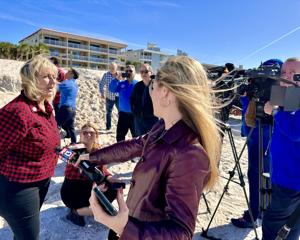
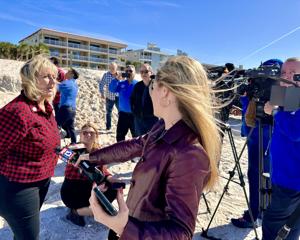
On Dec. 21, Indian Rocks Beach Mayor Cookie Kennedy and Pinellas County Public Works Director Kelli Hammer Levy held a press conference at the 20th Avenue beach access, where the sheared-off dunes illustrated the millions of dollars and months of work wiped out by the no-name storm of ’23.
“Obviously, we sustained damage on the beaches that were restored, including Pass-a-Grille and Sunset Beach, Treasure Island, Indian Rocks Beach and Belleair Beach,” Levy said.
“So, right now we are doing assessments and surveys to tell us how much we lost.”
Levy said the extent of the damage highlighted the fact that “winter fronts can be almost or as damaging as tropical fronts.” When asked for an estimate, Levy said, “Visually, it looks like (we lost) somewhere between 40 and 50% of the sand” from the county’s Emergency Beach Erosion Control project, a $37 million effort to restore some of the sand dunes that were wiped away by Hurricane Idalia in August.
Despite the setback, Levy said the work played a key role in protecting the existing shoreline properties.
“We were hoping we didn’t have to test it out this quickly and allow a period for the vegetation to get established,” she said, pointing to the rows of sea oats that dot the tops of the 10-foot-high dunes.
“But the bottom line is the dunes took the brunt of the storm, otherwise it would’ve hit property and structures. I absolutely think we would’ve had more damage. So yes, the dunes did their job.”
Kennedy agreed.
“As you can see, the dunes served their purpose,” she said. “They kept the water out of individual homes and businesses on the water. So, as far as we’re concerned, it did the job it was supposed to do.”
Kennedy, who has lived and worked in the county her whole life and is running for County Commission next year, said she can’t remember seeing so much damage being done to the Gulf Coast shoreline.
“I grew up in Largo and spent the last 35 years living as a business owner in IRB, and there’s definitely climate issues,” Kennedy said.f “We have never seen it like this since I was a little girl. So, we are very concerned.”
Asked what residents and visitors could do to help mitigate the issue, Kennedy suggested using the 25 of 27 beach accesses that are open, including at 17th and 18th Avenue, which have bathrooms and are handicap accessible.
“Our biggest concern is we want people to stay off the dunes,” Kennedy said. “We’re trying to keep as much sand as we can, and want everyone to be good stewards of the environment.”
Regarding the county’s immediate plans for the dune project, Levy said the next step would include evaluating survey data “and seeing what we need to do to stabilize” the dunes, either by adding more sand or shaving them down. “Then we’ll go segment by segment and develop a plan while at the same time we’re still constructing new dunes on Indian Shores today.”
As for a long-term solution to the regular beach renourishment that’s been stalled due to a stalemate between property owners and the U.S. Army Corps of Engineers, Levy said they’re working on that, too.
“We had already put out a bid for doing our own (renourishment) project, basically constructing the Corps’ project,” she said. The county “has the engineering firm selected, and we’ll be taking that contract to the board in January and getting that design underway.”
Levy explained how following Idalia the shoreline berm “lost a lot of height and width on the beach, and together the dunes, with the berm, provides the protection. We have the dunes, but we don’t have the berm. So, our plan is to get that berm constructed as soon as possible.”
For Kennedy — who’s advocated for critical beach renourishment for years, traveling to Tallahassee and Washington, D.C., with Levy and other local officials to plead their case — the news is long overdue.
“The beach has changed, and we need to change and adapt to the issues that we face,” she said. “We’re going to continue to try new measures because as an elected official, safety is the most important thing for our residents and business owners.”
[ad_2]


