
[ad_1]


By: Shelia Mader
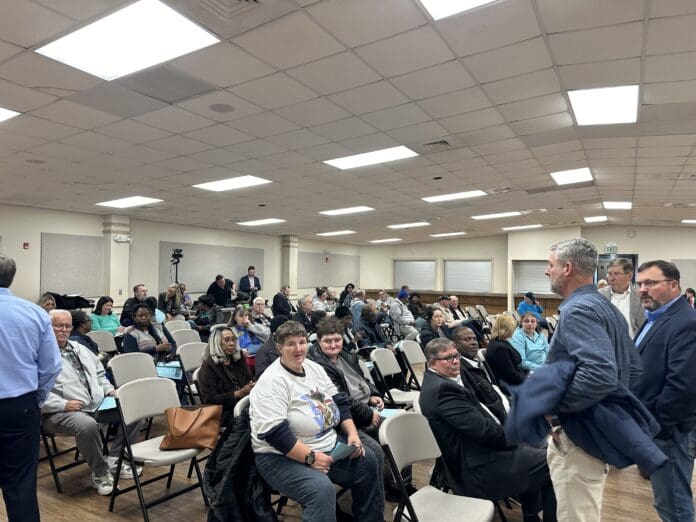
Concerns of poverty and increased levels of homelessness were just a few reasons Jackson, Liberty, and Calhoun County residents are battling against Florida Public Utilities’ proposed base rate increase. Many residents, community leaders and concerned business owners attended the public meeting held in Marianna, Wednesday, January 8.
FPU officials say they haven’t had a base rate increase since 2014, and a rate increase is necessary.
In the meeting held in Marianna, FPU’s electric operations, Matt Cutshaw, said, “Obviously, things have changed over the years. We’re trying to improve our infrastructure.”
Jackson County Schools superintendent Hunter Nolen says the district spent 1.7 million dollars on power last year and they are struggling with their current budget.
He said, “40% is a lot. If you raise it 40%, $700,000. We’re a small school district of 6000 students. We have 1100 employees. I have some things, some ideas, and ideas that I’d like to put in place for this upcoming school year. There are 67 counties in the state of Florida currently. Jackson County rates 40. That’s not acceptable to me.”
Nolen says the rate increase would negatively impact the school board’s ability to educate students and improve the county’s district rating. Of the three counties, Jackson and Calhoun counties have a nearly 20% poverty rate with Liberty County at 21.8%.
FPU’s other service area in Fernandina Beach has the same base rate and would also see the increase. But the poverty level is only at 8.7%. Cutshaw says the fact that the two areas have vastly different income brackets didn’t play a part in the development of the rate increase proposal.
“We do operate the same in both divisions. Both areas have similar employee base, similar salaries, similar costs in every way. So, it’s hard to divide that up with cost the same in both divisions, said Cutshaw.”
There was also concern from residents over FPU’s customer service. The Penn Avenue office closed its doors to the public during COVID-19 and has never reopened, with the convenient payment drop box no longer available either.
Walter Simpson said, “They’ve basically crippled us. They took away the box, so we have to depend on the U. S. Mail service or do money transfers through Western Union which requires us to go to a Western Union provider to pay the bill that we have no control over, no way to object or question the amount of the bill.”
Cutshaw stills insists the rate increase is necessary, “With the way the utilities operate, we were coming in short on being able to make a rate of return for our profit.”
One small business owner questioned FPU’s business model, “They continue to say this has increased and that has increased and they’re having trouble controlling those costs but at what point do you look internally to see if there’s a problem. With continued layoffs that I’ve seen locally since the physical office closed, they shouldn’t have the shortcomings they are professing to have.”
Cutshaw did say that the FPU hurricane Michael recovery charges will soon expire, and the company is reducing fuel charges.
Public Service Commission staff will make a recommendation to the commission by March 14th. The commissioners should decide on the rate case on March 20th.
[ad_2]


