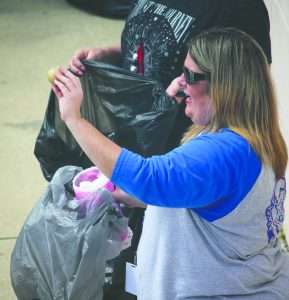

Each year eighth-grade science students at the middle school have fun experimenting with household goods fashioned into “egg-ships” carrying “egg-stronauts” launched from a roof overlooking the courtyard — this year by science teacher Adam Rothas.
Rothas lowered a cardboard box from a string to the courtyard so small groups of students could load up their flying-egg contraptions — many with parachutes attached — to be lifted skyward and strategically dropped, one by one, onto a spatter-proof target below.
In the meantime, students clocked the fall times from the same height to determine the respective speeds, or velocity, of the ships, which were then opened by another science teacher to determine whether the egg-stronauts survived the plunge safely in one piece.
The experiments were repeated until all of the eighth graders’ ships were tested to discover which techniques and materials protected the passengers and which ones failed upon impact, representing the culmination of the week’s lesson.
“This was the 19th year of the 8th grade Egg Drop Week,” explained Karen O. Padgett, science teacher and science club co-sponsor at BCMS. “Our current vice principal, Angela Rhoden, started it when she was an 8th grade science teacher in 2006. The only year we haven’t done it was 2020 due to Covid.”
She said many students turned to pool noodles to fashion their egg ships this year.
“Lots and lots of pool noodles. Bejeweled spacecraft were popular, too. Also, we saw fewer spacecraft made from, or with, new materials purchased specifically for the project. We stress to the kids that they should use items found around the house, not go out and buy things,” she said of the homework crafting projects.
She was also happy to report “many egg-stronauts were saved this year” with about 4-and-a-half dozen, or 54 eggs, that didn’t survive the landing compared to the usual 60-to-72 egg-stronauts.
“We purchased the eggs from our agriculture program for a feed donation. More projects were dropped, but fewer eggs were used, meaning more student hypotheses were supported by their research and design.
“The week-long project involves research, forming a hypothesis, designing and building a spacecraft, conducting the experimentation, and analyzing the data afterward. The egg drop process is fun, engaging, and satisfies Florida 8th grade science standard SC.8.N1.1,” said Padgett. “We also had a record number of projects dropped in a single class period this year. Our third-period egg drop saw 40 spacecraft fly off the roof among five science periods participating on March 13. We had a total of 173 spacecraft dropped from 5 meters (16 feet, 5 inches) on the day.”


