
[ad_1]

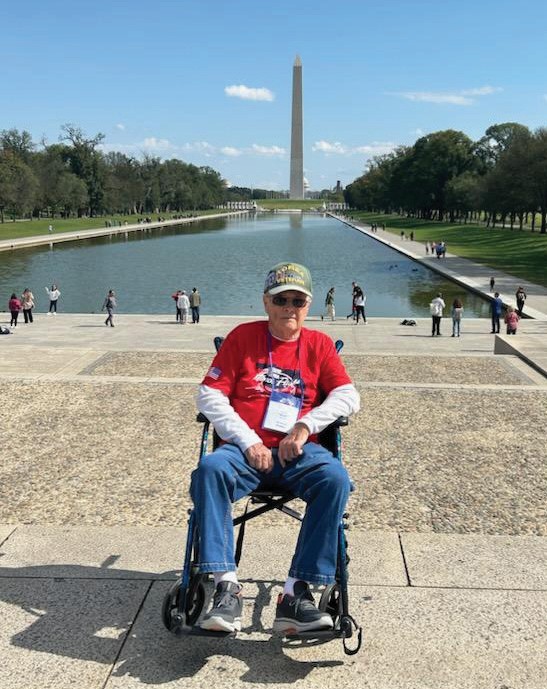
Robert E. Ritter just lately joined an Honor Flight, the place veterans visited battle memorials in Washington, D.C. COURTESY PHOTOS
At 90, Robert E. Ritter’s seems to be belie his age. Ritter earned a Purple Coronary heart within the Korean Battle, typically referred to as the “forgotten battle,” fought from 1950 to 1953.
He presently lives alone in his dwelling in West Nokomis and is totally self-sufficient. He served as major caregiver for his spouse of 70 years, Rosie, who died in 2022.
He remembers a battle that he now seems to be again on as each “a waste of time” and “a waste of lives,” he stated. But, “I’m glad I served.”
Korea known as the forgotten battle as a result of it was largely overshadowed by World Battle II, which preceded it and the Vietnam Battle, which got here after. There have been no throngs of cheering crowds greeting the ship that returned him to the states after his service, like in World Battle II, Ritter stated.
The 2 Koreas had been separated on the thirty eighth parallel. The battle started June 25, 1950, after the communist North Korean forces invaded the non-communist South. United Nations forces (led by Individuals and largely composed of Individuals) helped the South Koreans battle towards the North Koreans, who had been supported by troopers from China and the then-Soviet Union.

Ritter was injured whereas serving in Korea. He earned a Purple Coronary heart.
Ritter served with the Marines for 14 months in Korea, beginning in February 1952. A month later, he had his nineteenth birthday.
Most of his combating was within the space of Bunker Hill, an outpost in the midst of what’s now referred to as the DMZ, or demilitarized zone between North and South Korea. He referred to as it “little greater than a low bump within the street.”
Bunker Hill noticed a number of the most ferocious combating through the battle, significantly in a battle between Aug. 9 and Sept. 30, 1952.
The combating could be each evening, below cowl of darkness, Ritter stated. Not a lot was happening through the day. The nightly skirmishes would come with wherever from 500 to 1,000 individuals. First one aspect would take the hill then the opposite, Ritter stated. “They fought over it like loopy.”
This was trench warfare and bunker warfare, Ritter stated. Bunker Hill, because the title implies, was coated in bunkers, with a number of troopers in every. At evening the air was filled with the sound of artillery and mortar fireplace. The fight was typically hand-to-hand.
“Anyone who doesn’t let you know it was scary is mendacity,” he stated. “I noticed guys moist their pants.”
The North Koreans pushed younger boys ahead upfront of the troops, carrying sticks and brooms. The troopers adopted, together with girls of their ranks. However they had been all dressed alike and in battle, you couldn’t inform who was who, Ritter stated. The ladies additionally dug trenches and ready meals, he stated.
Requested how he earned his Purple Coronary heart, Ritter was overcome with emotion and tears started to stream. He wasn’t in a position to articulate any particulars. Suffice it to say he was in a bunker with different troopers. Mortar fireplace exploded round them. He was wounded with shrapnel.
“It wasn’t very nice,” he stated. His harm obtained him out of responsibility for 4 days.
Ritter remembers being current when the armistice was signed on July 27, 1953. It occurred in one other room exterior his view, however he noticed the parade of POWs being exchanged — the Individuals launched by the North Koreans and vice versa. When he got here dwelling, 300 American POWs had been on the ship with them.
There was no peace treaty, so technically, the 2 sides are nonetheless at battle. The armistice left the boundary between North and South Korea about the identical because it was earlier than the battle started.
“They didn’t settle something.” Not less than in World Battle II, any person gained, Ritter stated.
Ritter got here dwelling and married his highschool sweetheart, Rosie. He remained with the marines at Camp Lejeune in North Carolina till his service resulted in 1955. Different medals he earned are the Korean Service Medal, UN Service Medal and Nationwide Protection Service Medal.
Ritter was born in Piqua, Ohio, and the couple settled in Troy, north of Dayton. Then it was again to a standard life. He labored first in a machine store together with his father, then labored for a glass firm for 40 years, managing one of many firm’s shops.
He additionally is aware of he suffered from what’s now referred to as PTSD. “My spouse stated I did,” he stated. There’s additionally a way of survivor’s guilt, questioning, why am I nonetheless alive whereas somebody combating two toes away from me will get wounded or killed?
He has three youngsters, daughter Jan and two sons, Robert J. and John. He additionally has seven grandchildren and 9 great-grandchildren
His son Robert J., who lives in Punta Gorda, can also be a military veteran who served in a help position sustaining plane simply earlier than the beginning of the Iraq Battle. He works half time at Punta Gorda Airport and noticed details about the nonprofit Southwest Florida Honor Flight, which flies out of the airport. The group honors veterans from World Battle II, Korea, Vietnam and different wars by taking them on a whirlwind journey to Washington, D.C., for gratis to them, to go to and mirror at their memorials and be honored for his or her service.
Robert J. went on the dignity flight Oct. 10 together with his father. “It’s such a terrific expertise,” he stated. “For lots of vets, it brings again unhealthy reminiscences. For others, it brings again good reminiscences.” His father obtained to see the Vietnam Wall and Arlington Nationwide Cemetery. When he obtained to the Korean Battle Memorial, “the look on his face stated all of it,” Robert J. stated.
The tears started to stream. ¦
[ad_2]


